
Known throughout the world, Belém Tower, also called St Vincent Tower, is one of Portugal's cultural and architectural iconic monuments. Classified as World Heritage site by UNESCO, it is often presented as the country's picture.






Known throughout the world, Belém Tower, also called St Vincent Tower, is one of Portugal's cultural and architectural iconic monuments. Classified as World Heritage site by UNESCO, it is often presented as the country's picture.


One of the most famous Portuguese monuments, located in Belém, the Jerónimos Monastery is considered a masterpiece of Portuguese architecture from the 16th century and the greatest Manueline style icon. .It was built in limestone (material brought from various locations in the surrounding area), in the former Santa Maria de Belém church site.
The construction of this Palace is associated with a curious Portuguese History fact: after the 1755 Lisbon earthquake, King José had a tent complex installed in the Ajuda area (dubbed the "Royal Hut"). This area of the city is characterized by a low seismic risk and so the monarch moved there with his entourage. After a fire destroyed this structure by the end of the 18th century, the royal family gave orders for the construction a more solid building, then named Nossa Senhora da Ajuda Royal Palace.
The Mafra National Palace consists of a Royal Palace, a Basilica and a Convent. It was completed in 1735, by King João V, and became the residence of the royal family for a few years, until the monarch’s death. Even after that, it never ceased to be one of the court's favourite places. Later, during the French invasions of the early 19th century, and with the Portuguese royal family exiled in Brazil, the Palace was stripped of many of its treasures.
The National Coach Museum is the most popular and most visited museum in Portugal. Inaugurated in 1905, in the former Royal Riding Arena of Belém, its main objective was to exhibit an original collection of gala cars and strolls from the 16th to 19th centuries, belonging to the Portuguese Royal House.
Later, the Church's cars and private pieces joined the collection, forcing an expansion. After the implantation of the republic in Portugal (and the collapse of the monarchy), the museum adopted its current denomination: National Coach Museum.
With a collection of over 250,000 pieces linked to the theatre, this Museum is located in Monteiro-Mor Palace, an 18th-century building that has been adapted for this purpose.
The first attempts to create a museum focused on the performing arts date back to the early 20th century, but only in 1979 did these plans come to life. The space was officially created in 1982 and inaugurated in 1985.
The Popular Art Museum is one of the more iconic works of Estado Novo (the authoritarian regime imposed in Portugal in 1933), created after the reform of the Portuguese World Exhibition's Section of Popular Life pavilion, in 1940. Projected by architects António Reis Camelo and João Simões, this Museum was a result of the program of António Ferro, the director of the Secretariat of National Propaganda.
Founded in 1893 by José Leite de Vasconcelos, the national Museum of Archaeology settled in the Jerónimos Monastery in 1903 and opened to the public two years later, in 1905.
With a privileged view over Praça do Império gardens, in Belém district, the museum displays extensive collections, having accumulated, throughout its history, a wide collection in the most diverse areas, namely archaeology, ethnography, jewelry, numismatics, medals, sculpture or mosaics. Of greater prominence are the collections of Portuguese archaeology, of several periods throughout History.
This museum celebrates one of the most iconic arts in Portugal: the ceramic tile, or azulejo. It has a privileged historical location, in the former Convent of Madre Deus (founded in 1509, by Queen Leonor).
After significant works were carried out in the building to commemorate the 500th anniversary of the founding queen's birth, the museum opened in 1965, concentrating the most iconic national tile collection, which until then had been spread over various sites.
The National Museum of Ancient Art has been installed for almost 130 years in Alvor Palace, in Santos district, after the former Fine Arts National Museum was divided up.

The international conference Green Horizons – Shaping the Modern Age will take place in...

Portugal remains one of the most preferred destinations for congresses and conventions,...
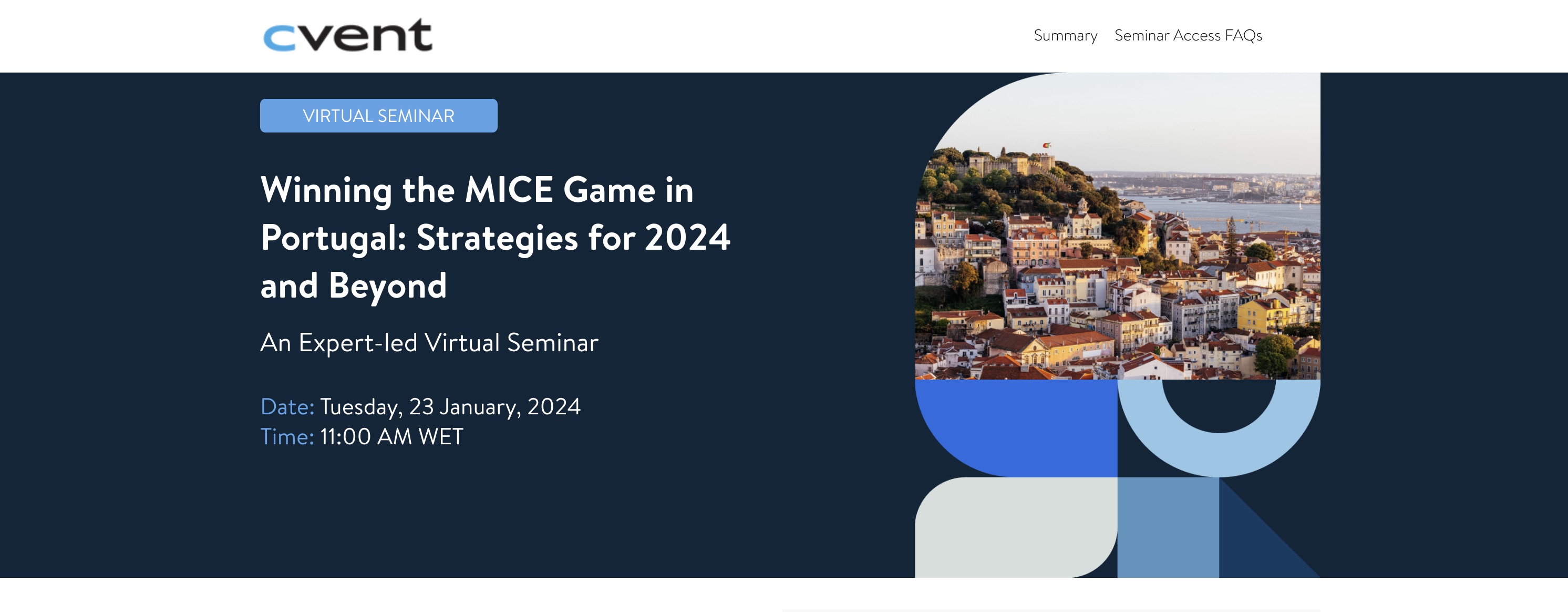
Cvent is delighted to announce the inaugural market-specific virtual seminar for the year. ...



 Aguarde um momento...